
- No AI lab has confirmed that its engines read llms.txt, and Google’s guidance says Search and its generative AI features do not use the file
- Ahrefs studied 137,210 sites in May 2026: 28% published an llms.txt, and 97% of those files got zero requests all month
- Publish one anyway, because it takes five minutes, breaks nothing, and forces you to list your best pages in one place
- Citations come from crawler access, search rank and answer-first writing, not from a text file at the root of your site
Most guides in this niche tell you to publish an llms.txt file and wait for ChatGPT to start quoting you. That advice does not survive contact with server logs. No, ChatGPT and Perplexity do not read llms.txt in any way anyone has been able to measure. No major AI lab has confirmed support for the format, Google’s documentation says you do not need machine-readable files like this to appear in Google Search including its generative AI features, and when Ahrefs looked at 137,210 sites in May 2026, 97% of the published llms.txt files received zero requests across the entire month.
Publish one anyway. It takes five minutes, it cannot hurt you, and writing it forces you to decide which twenty pages on your site actually matter. Just stop treating it as the move that earns citations, because the evidence says it is not. The work that moves AI visibility sits somewhere else entirely, and this post shows you where.
Do ChatGPT and Perplexity Read llms.txt Files?
ChatGPT and Perplexity do not read llms.txt files, on all the public evidence available in 2026. OpenAI, Anthropic, Google and Perplexity have never announced support for the format. Google’s John Mueller was blunt about it, saying that as far as he knows none of the AI services have said they use llms.txt, and that you can tell from your server logs they do not even check for it. He compared the file to the keywords meta tag, which search engines dropped decades ago because site owners simply declared whatever they wanted. Source: Search Engine Journal.
The Ahrefs data backs him up with numbers. Across 137,210 sites tracked in May 2026, roughly 38,000 published a valid llms.txt. Only about 1,100 of those files were requested even once. Of the requests that did land, 96% came from bots, and the largest slice was SEO audit tools at 21.7% rather than AI crawlers, which accounted for 19.5%. The most telling finding: on sites with no llms.txt at all, AI bots never requested one. They are not looking for it.
Google’s position is now written down rather than implied. The Search Central guidance states that a site does not need machine-readable files, AI text files, or Markdown to appear in Google Search including its generative AI capabilities, which pulls AI Overviews and AI Mode into scope. Gary Illyes has said publicly that Google does not support llms.txt and has no plans to. See the Google AI features optimization guide for the current wording.
So publication is not adoption. The llms.txt specification exists, it is well designed, and Jeremy Howard proposed it in good faith in September 2024. It is a proposed convention that a handful of inference-time agents honour and every major retrieval crawler ignores. Treat it as that, and you will make better decisions about where your hours go.
The Anatomy of an llms.txt File
An llms.txt file sits at the root of your site and follows a simple markdown structure. It opens with an H1 carrying your brand name, then a blockquote summarising what the site is, then free-form context, then H2 sections holding lists of links in the format link, colon, one-line description. An optional Ignore section lists what you would rather agents skipped.
The body is a curated index of your best pages. Pricing, about, the flagship guides, the product pages that actually convert. Admin screens, checkout steps and tag archives stay out. That curation exercise is the honest reason to write the file, because most site owners cannot name their twenty best pages without opening analytics, and the ones who can tend to write better internal links afterwards.
| Feature | robots.txt | sitemap.xml | llms.txt |
|---|---|---|---|
| Primary function | Access control | URL discovery | Curated context and priority |
| Target audience | All web crawlers | Search engines | Large language models |
| Format | Directives (Allow/Disallow) | XML list of links | Markdown context |
| Status | Long-standing convention, universally honoured | Long-standing convention, universally honoured | Proposed convention, no engine has confirmed support |
| Required | Yes | Yes | Optional |
| Citation impact score (of 10) | 9.5 via URL accessibility | Feeds search rank at 9.4 | 2.0, lowest of 23 measured factors |
Those scores come from a 2026 meta-analysis of 55 experiments, patents and case studies, mapped out in full in our WordPress AEO checklist. Llms.txt finished last of 23. Robots.txt, through the URL accessibility it controls, finished first.
Writing the file by hand is dull and it goes stale the moment you publish anything. AEO God Mode serves /llms.txt as a virtual route built from your real published content, so there is no static file to upload and no FTP involved. It caches for about 24 hours, and there is a Regenerate button when you want it rebuilt sooner.
- ✓Costs five minutes and creates zero risk to your SEO
- ✓Forces you to curate and rank your own best pages
- ✓A small number of inference-time agents do fetch and follow it
- ✓Cheap insurance if any engine adopts the convention later
- ✗No major AI engine has confirmed reading it, and Google says its generative features do not use it
- ✗97% of published files got zero requests in May 2026
- ✗Goes stale fast unless something rebuilds it for you
- ✗Cannot block anything, because it is a suggestion list and not an access control
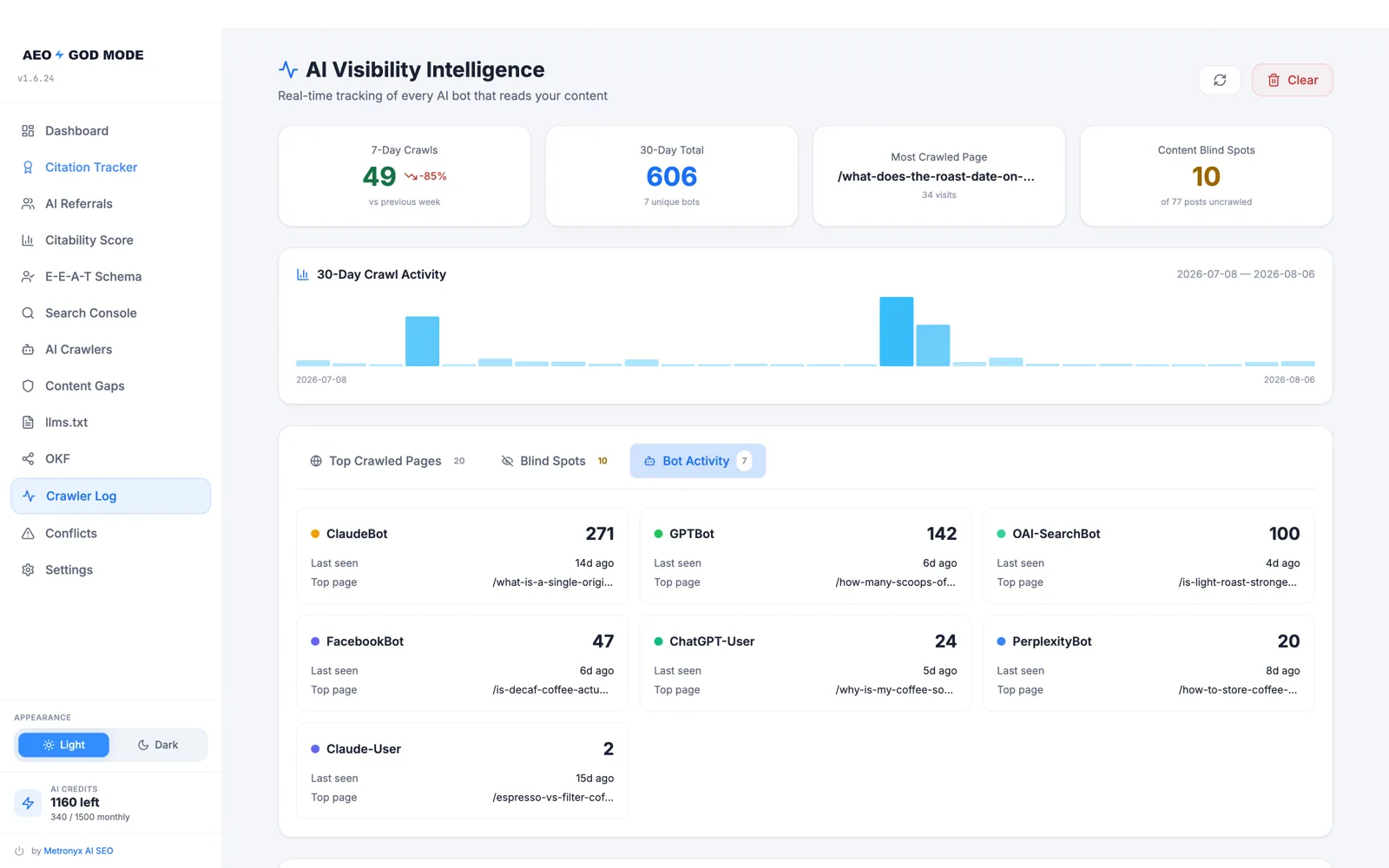
Identifying Which Bots Scan Your Server
Since llms.txt is not doing the work, crawler access is. If an AI bot cannot fetch your pages, nothing else on this list matters, which is why URL accessibility scores 9.5 out of 10 while llms.txt scores 2.0. Your server logs tell you which bots actually arrive and what they get back.
OpenAI runs GPTBot for training, OAI-SearchBot for search indexing, and ChatGPT-User for live user-triggered fetches. Anthropic runs ClaudeBot. Perplexity runs PerplexityBot. Apple runs Applebot, Amazon runs Amazonbot, ByteDance runs Bytespider, and Meta runs FacebookBot and meta-externalagent. Cohere and DeepSeek operate their own crawlers too.
One correction worth making, because plenty of articles get it wrong: Google-Extended is not a crawler. It is a robots.txt product token that tells Google whether content already fetched by Googlebot may be used for Gemini training and grounding. You will never see it in your logs, and blocking it changes nothing about how you are indexed or ranked in Search.
Read your logs before you change anything. Reading WordPress AI crawler logs tells you whether these bots are getting 200s or quietly collecting 403s from a security plugin or a bot challenge. A blocked crawler is the single most expensive AEO mistake there is, and it is invisible from the front end.
The 10 Signals That Make Content Citable
Getting fetched is step one. Getting quoted is a separate problem, and answer engines score your page during retrieval. These are the ten signals that carry the most weight, scored out of 10 in the same 2026 meta-analysis:
- URL accessibility (9.5). The bot gets a 200 and server-rendered HTML. No bot challenge, no paywall, no client-side-only content.
- Search rank (9.4 for Google’s AI, far less elsewhere). Google AI Overviews and AI Mode pull from Google’s own index, and Perplexity partly does too. ChatGPT, Claude and Gemini frequently cite pages that rank nowhere in Google’s top 10, so treat rank as a floor for Google’s surfaces rather than a universal lever.
- Fan-out rank (9.3). Engines break one prompt into four to eight sub-queries. Ranking for the sub-questions beats ranking for the headline query.
- Preview control (9.2). Title, meta description, OpenGraph image and the first 200 words. That bundle decides whether you get quoted.
- Query-answer match (9.2). The question appears verbatim in a heading, and the answer sits in the next two sentences.
- Intent-format match (9.0). Definitional questions get a one-sentence definition. How-to questions get a numbered list. Comparisons get a table.
- Topic cluster ranking (8.9). A pillar page with five to eight interlinked spokes beats one long article every time.
- Answer near the top (8.8). The quotable passage belongs in the first 200 words, above any preamble.
- AI-ready structure (8.6). A heading every 200 to 300 words, short paragraphs, no walls of text.
- Factual precision (8.3). Real numbers, named entities, dates. Replace every “many” and “huge” with a figure.
Notice what is absent from that list. Llms.txt does not appear, and neither does schema markup. Both sit in the bottom third. If you want the full ranking with the methodology behind it, making content extractable for AI systems covers the writing side, and the AEO checklist covers the technical side.
Where Schema Markup Actually Fits
Schema markup is a weak correlate of AI citation rather than a proven cause of it, and anyone telling you it is mandatory for 2026 is guessing. In a controlled Ahrefs test published in May 2026, adding schema moved AI Overviews citations by -4.6%, AI Mode by +2.4% and ChatGPT by +2.2%, with the last two statistically indistinguishable from zero. Most large language models do not parse JSON-LD when they fetch a page, with Gemini as the exception. Google’s own 2026 optimization guide lists overfocusing on structured data as a myth.
None of that makes schema worthless. Article and FAQPage markup earn rich results in classic search, and classic search rank is what feeds Google’s AI surfaces. So ship valid schema once, keep it accurate, and stop there. Score it as infrastructure, not as a citation lever.
What does hurt is duplicate or broken output. Two plugins both emitting Article schema produces conflicting graphs that validators reject and crawlers discard. Run a schema validator check and make sure exactly one plugin owns your JSON-LD. If Rank Math or Yoast is already handling the basics, your AEO layer should defer to them and fill gaps only.
Tracking AI Citations and Referrals
Publishing and hoping is not a strategy. Because citations differ per engine and change fast, the only honest way to know whether any of this works is to check where you actually appear. ChatGPT and Perplexity share only around 11% of their cited domains, which means a win on one tells you very little about the other.
Standard analytics will not do it for you. Traffic from AI answers arrives as direct or as a generic referral, so it hides inside the numbers you already have. Detecting citations means asking the engines your buyers’ questions on a schedule and matching your site against the sources they return, which is what the AI Citation Tracker does.
The traffic is worth chasing even at low volume. Semrush’s 2026 data puts AI search visitors at 4.4 times the value of the average traditional organic visitor, because someone arriving through a citation has already had the basic question answered and is following the link to verify or to buy. Small numbers, high intent.
Technical Setup and Implementation
On WordPress this splits cleanly into two layers. Your existing SEO plugin keeps title tags, meta descriptions and XML sitemaps. An AEO layer handles crawler access rules, llms.txt generation, answer-density scoring and citation tracking. They should not overlap, and a well-behaved AEO plugin detects what you already run and defers to it.
A word on HTTP headers, since this post is about honesty. AEO God Mode can emit headers such as X-AI-Crawl, X-AI-Citeable and X-Content-License, plus a Link header pointing at your llms.txt. These are our own convention, not a ratified standard, and no engine has agreed to read them. They are in the same category as llms.txt: free to send, zero downside, no promised return. Anyone selling you custom headers as a citation mechanism is doing the same thing this post is arguing against. For the wider picture, see our guide to AI HTTP headers.
If you want the plumbing handled, download the free plugin. The free version detects your existing SEO setup, prevents conflicts, serves llms.txt as a virtual route and logs every AI bot that visits. Agencies running this across client sites can compare AEO God Mode pricing plans for unlimited activations.
So Should You Publish an llms.txt File?
Yes, publish one, and expect nothing from it. That is the whole honest answer. The file costs five minutes, carries no SEO risk, forces a useful bit of curation, and covers you if an engine adopts the convention in 2027. Those are decent reasons. “ChatGPT will read it” is not one of them, and any tool or agency claiming otherwise is selling you a story the server logs do not support.
Then spend the afternoon you just saved on the things that scored 9 out of 10. Confirm GPTBot, ClaudeBot, OAI-SearchBot and PerplexityBot get a 200 instead of a 403. Put your buyers’ actual questions in your H2s and answer them in the next two sentences. Build one pillar page with six spokes around it. Those are the moves that get you quoted, and none of them involve a text file at the root of your site.
Frequently Asked Questions
Does ChatGPT read llms.txt?
There is no evidence that ChatGPT reads llms.txt. OpenAI has never announced support for the format, and the Ahrefs May 2026 study of 137,210 sites found that 97% of published llms.txt files received zero requests of any kind during the month. Where AI bots did fetch the file, they accounted for only 19.5% of requests, behind SEO audit tools at 21.7%.
Does Google use llms.txt for AI Overviews?
No. Google’s Search Central guidance states that a site does not need machine-readable files, AI text files or Markdown to appear in Google Search, including its generative AI capabilities, which covers AI Overviews and AI Mode. Gary Illyes has said publicly that Google does not support llms.txt and has no plans to. John Mueller compared the file to the keywords meta tag.
Does Perplexity read llms.txt files?
Perplexity has never confirmed support for llms.txt. PerplexityBot fetches pages directly and scores them for citation the same way it scores any other source. Making your pages easy to fetch and easy to quote does more for Perplexity visibility than any file at your site root.
Is llms.txt an official standard?
No. Llms.txt is a proposed convention, published by Jeremy Howard of Answer.AI in September 2024 at llmstxt.org. It has no standards body behind it and no confirmed adoption from OpenAI, Anthropic, Google or Perplexity. A lab publishing its own llms.txt for its documentation is not the same as that lab’s crawlers reading yours.
Should I still create an llms.txt file in 2026?
Yes, but only because it is cheap. The file takes five minutes, carries no SEO downside, and forces you to list your best pages in one place. Treat it as a five-minute task with an unproven payoff rather than as an AI visibility strategy. In a 2026 meta-analysis of 55 experiments, llms.txt scored 2.0 out of 10, the lowest of 23 measured citation factors.
Where does the llms.txt file go on a WordPress site?
At the root of your site, so it resolves at yoursite.com/llms.txt. On WordPress you do not need to upload anything, because a plugin can serve it as a virtual route built from your published content. AEO God Mode does this and caches the result for around 24 hours, with a Regenerate button when you want it rebuilt sooner.
What is the difference between llms.txt and robots.txt?
Robots.txt is an access control that every major crawler honours, and it decides whether AI bots can fetch your pages at all. Llms.txt is a suggestion list with no enforcement and no confirmed readers. Robots.txt governs URL accessibility, which scored 9.5 out of 10 for citation impact. Llms.txt scored 2.0. Get robots.txt right first.
What actually gets a WordPress site cited by AI engines?
Four things, in order. Let AI crawlers fetch your pages and return 200s. Rank in Google, which feeds AI Overviews, AI Mode and part of Perplexity. Put the real question in an H2 and answer it in the next two sentences. Build topic clusters instead of one long article. Schema markup and llms.txt sit in the bottom third of the 23 measured factors, so ship them once and move on.