
Entity stacking is how you make a brand legible to machines. You build a consistent, cross-verified trail of profiles, mentions, and structured data so Google’s Knowledge Graph, and the AI engines sitting on top of it, can say with confidence who you are and what you are known for. That is the whole job: be verifiable from several independent directions at once.
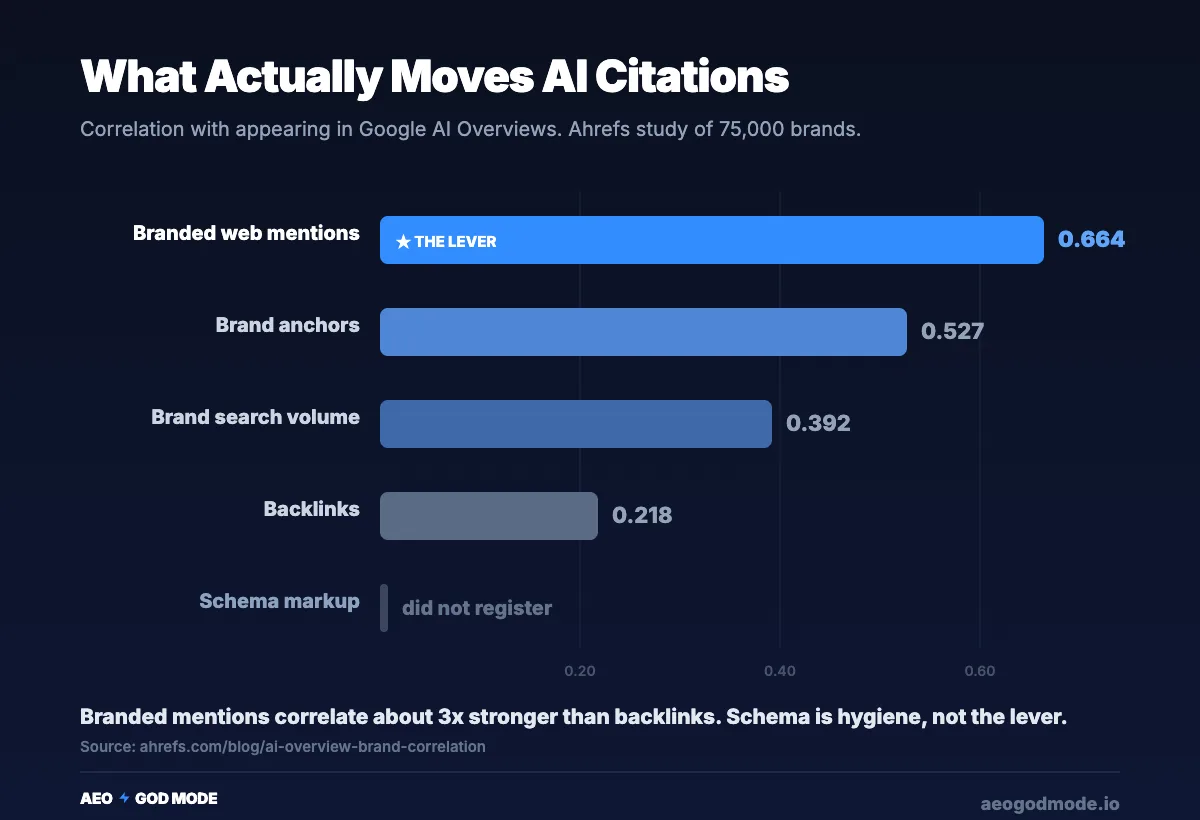
Here is where most guides go wrong, and I will plant the flag early. They tell you to start with schema markup, the so-called hidden layer. That is backwards. Schema is the weakest of the three layers for getting cited. In Ahrefs’ study of 75,000 brands, branded web mentions correlated with showing up in Google AI Overviews at 0.664, the strongest single signal they measured. Backlinks sat at 0.218. Schema did not make the chart. So if your entity stack is a weekend of hand-coded JSON-LD and nothing else, you polished the smallest lever and skipped the big one.
TL;DR Entity stacking is a cross-verified web of profiles, mentions, and structured data that proves your brand is a real, trusted entity to AI engines. It has three layers, and the order people work them in is usually wrong.
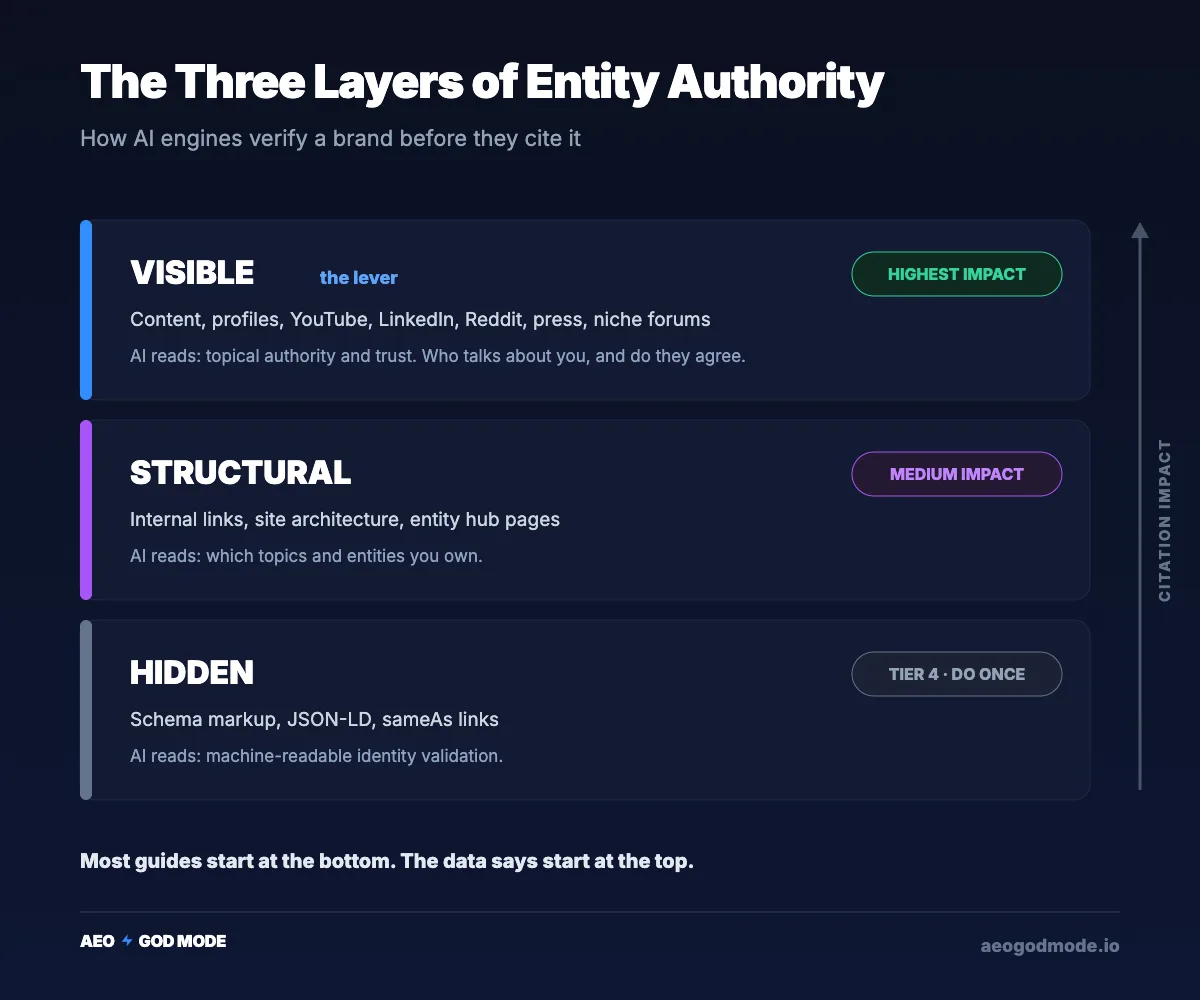
- Three layers: Hidden (schema and sameAs), Structural (internal links and entity hub pages), Visible (content, profiles, third-party mentions).
- The Visible layer moves citations most. The Hidden layer (schema) is a Tier-4 signal, worth about 5.6 out of 10. Do it once and stop.
- Audit each layer, fix what is broken, then weight your ongoing hours toward mentions and a clean internal link graph.
- Brand mentions correlated with AI Overview appearance at 0.664 versus 0.218 for backlinks (Ahrefs, 75,000 brands). That gap is the strategy.
- A missing Knowledge Panel is a tell that your entity is not verified yet. Wikidata plus press coverage is the fastest route to one.
What is entity stacking in AEO?
Entity stacking is the practice of building a layered, cross-referenced set of signals across the web so AI systems and search engines can identify, understand, and trust your brand as a recognised entity. Think of it as a fingerprint that several independent sources confirm, rather than a claim you make about yourself on your own site.
Search engines stopped being keyword machines a while ago. Google maps things now: people, brands, places, concepts, and the relationships between them. An AI answer engine pulls from that same map. So the question is no longer only “does this page mention the keyword”, it is “does this entity exist, is it consistent, and is it trusted enough to quote”. Entity stacking is the work that makes the answer yes.
There are two readings of the term worth knowing, because people use it to mean both. The first is the link-building reading: building references from high-trust platforms (Google Business Profile, LinkedIn, Crunchbase, Wikipedia, industry directories) back to your site, each one a layer of credibility. The second is the wider AEO reading: lining up your identity, your area of expertise, and your organisation details so they match everywhere, so an AI can verify who you are and what you are authoritative about. Both are correct. The wider reading is the one that pays.
Why does entity stacking matter for AI search?
Because AI answer engines cite brands they can triangulate from several independent sources, and they skip the ones they cannot. If your entity is thin or inconsistent, ChatGPT, Gemini, Perplexity, and Google’s AI Overviews have no confident way to attribute a claim to you, so you do not get named.
This is the part that reframes the whole effort. Great content alone does not get you cited if the engine cannot work out who published it. The strongest correlation Ahrefs found for AI Overview appearance was branded web mentions at 0.664, well ahead of brand search volume at 0.392 and backlinks at 0.218. Being talked about, by name, in places that line up with each other, is the signal. Entity stacking is how you manufacture that on purpose instead of waiting for it.
What are the three layers of entity stacking?
Hidden, Structural, and Visible. The Hidden layer is the structured data a machine reads, the Structural layer is how your own pages connect to each other, and the Visible layer is everything the public sees and says about you across the web. Here is what each maps to and what an engine does with it.
| Layer | What it covers | What Google and AI use it for |
|---|---|---|
| Hidden | Schema markup, JSON-LD, sameAs links | Machine-readable entity validation |
| Structural | Internal links, site architecture, entity hub pages | Working out which topics and entities you own |
| Visible | Content, profiles, third-party mentions, citations | Topical authority and trust signals |
The mistake is treating these as equal, or worse, ranking them in the order above. They are not equal, and the impact runs in reverse of how they get taught. Visible does the heavy lifting, Structural makes your site readable as a set of related entities, and Hidden is a quick hygiene pass that stops engines guessing your basic facts. Hold that thought, because it decides where your week goes.
How do you map your brand’s footprint against the three layers?
You run a short audit per layer and write the findings into one table. The goal is to spot wherever an engine cannot triangulate you, which is anywhere your identity is missing, broken, or contradicts itself. Work layer by layer.
Audit the Hidden layer. This is the most overlooked, and usually the most broken.
- Run the site through Google’s Rich Results Test and the Schema.org validator. Look for Organisation, Person, Product, and where relevant LocalBusiness.
- Check your
sameAsproperty. It should point to your LinkedIn, YouTube, Wikidata, Crunchbase, and other authority profiles, so engines can cross-check your identity. A missing sameAs is the single most common gap I see. - Use Screaming Frog’s structured-data report to find which pages carry schema and which are bare.
- Confirm the JSON-LD lives in your server-rendered HTML. If JavaScript injects it after load, most AI crawlers never read it.
Audit the Structural layer. This maps how well your own pages connect entity ideas instead of leaving them stranded.
- Pull your internal link graph with Screaming Frog or Ahrefs’ internal links report. Find orphan pages and disconnected clusters.
- Check that your entity hub pages (About, product or service pages, author bios) link to and from each other and to supporting posts. A CEO bio that links to the About page that links to a press mention is the pattern you want.
- Verify crawl depth. An entity page buried four or more clicks from the homepage is close to invisible to an AI crawler.
- Confirm each topic cluster points back to a pillar page that defines the topic you want to own.
Audit the Visible layer. This is the external footprint, owned and earned.
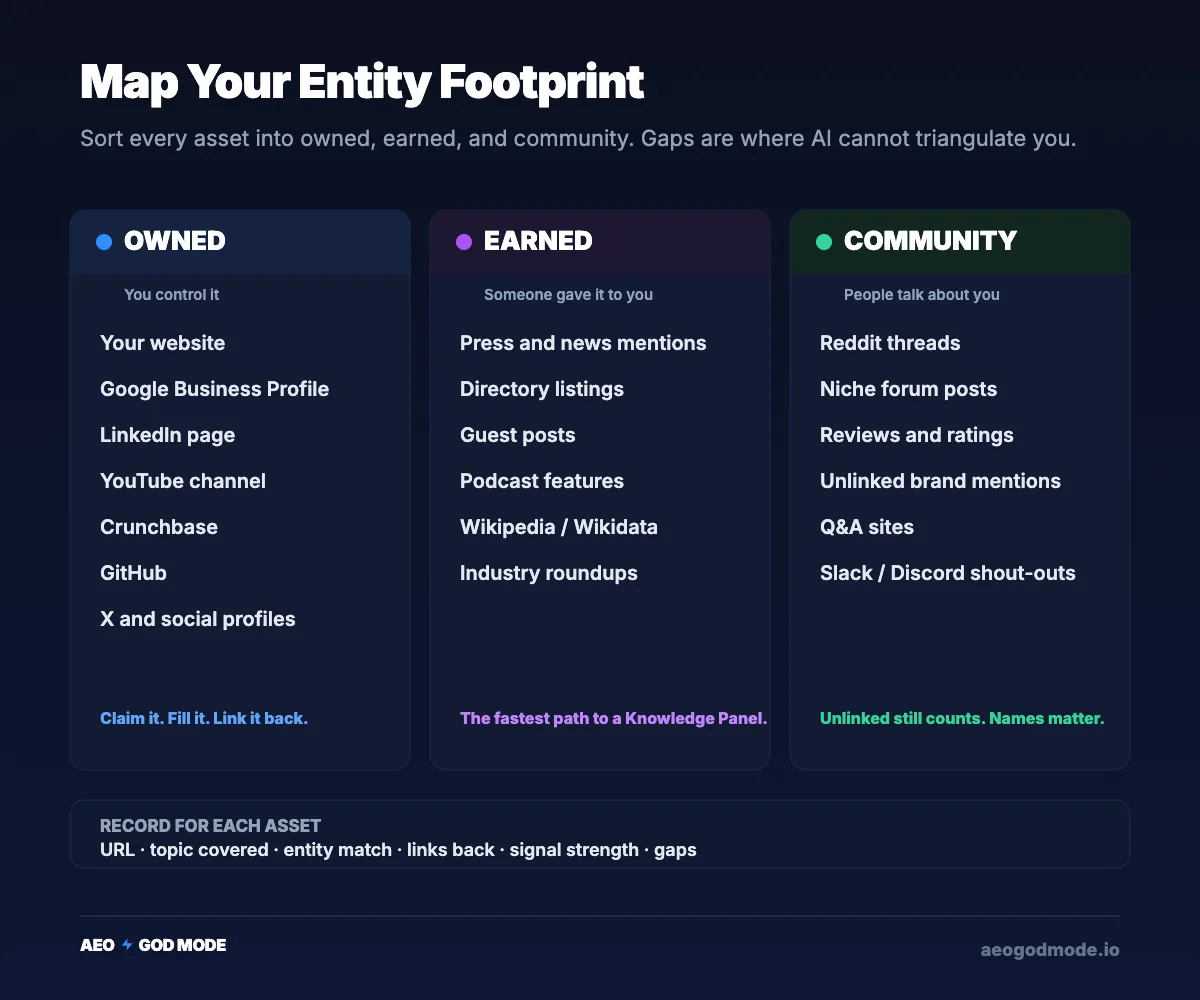
- Owned profiles: Google Business Profile, LinkedIn, YouTube, Crunchbase, GitHub. Every active platform should be claimed, fully filled out, and linked back to your site.
- Citation consistency: your brand name, URL, and details must read identically everywhere. Even a small variant (“AEO God Mode” versus “AEOGodMode”) confuses the entity graph.
- Third-party mentions: track them with Google Alerts, Ahrefs, or Semrush. Note which carry a link and which are unlinked mentions, because both count.
- AI engine presence: ask ChatGPT, Gemini, and Perplexity who you are. If the description is vague, wrong, or absent, your Visible layer is too thin.
- Knowledge Panel status: no panel is a clear sign the entity is not verified yet. A Wikidata entry plus real press coverage is the quickest path to earning one.
Which layer should you fix first?
Fix the Hidden layer first, but only once, then spend the rest of your time on Structural and Visible. A broken or missing Organisation or sameAs blocks machine reading at the root, so it has to be clean. After that, schema is a Tier-4 signal and gives almost nothing back for extra effort.
The numbers back this order. In the 23-factor AEO checklist, Brand and Entity Trust scores 6.8 out of 10, Entity Consistency 5.8, and Structured Data 5.6. Ahrefs’ controlled test of 1,885 pages found that adding schema moved AI citations by -4.6% on AI Overviews and roughly +2% elsewhere, statistically a wash. So treat the Hidden layer like wiring a plug: get it right, then forget it. Reconnect your orphan pages next. Then put your standing effort into mentions, because that is the 0.664 lever and it compounds.
The Visible layer is more than profiles
Claiming directories is table stakes. The footprint that proves a brand is active is the trail of public content that keeps repeating the same identity and the same topic. That is where most stacks are thin, and where a few deliberate assets go a long way.
Make a YouTube video on your topic. It acts as a topical authority signal, especially when it backs up the same subject cluster as your site, and it gives engines a second source on a high-trust site. Write a LinkedIn post or article on the same idea, which ties professional credibility to your name and brand. Start or join a niche forum thread, and answer a real question in your area. Reddit discussions, guest posts, podcasts, and directory listings all add third-party signals that say the brand exists and is talked about. None of these is a magic bullet. Together they are the footprint.
To map them, build a table and sort every asset into owned, earned, or community:
| Column | What to record |
|---|---|
| Asset type | YouTube video, LinkedIn post, forum thread, directory, press, profile |
| URL | The live link |
| Topic covered | Which subject cluster it supports |
| Entity match | Does the name, brand, and URL match your canonical version |
| Links back | Linked, unlinked mention, or none |
| Signal strength | High, medium, low by site trust and topical fit |
| Gaps | Wrong name, no link, off-topic, stale |
The rule of thumb: if an asset helps a search engine or an AI answer “who is this brand, what is it about, and why should it be trusted”, it belongs in the Visible-layer map. By that test, a YouTube video, a LinkedIn article, and a niche forum thread all qualify, and all three are within reach this week.
How does AEO God Mode help with entity stacking?
It handles the parts you can automate and measures the parts you cannot. Entity Consistency, clean Organisation and Person schema with sameAs, internal linking between your hub pages, and the tracking that tells you whether any of it is working.
Here is the honest version, because schema-led tools tend to oversell this. AEO God Mode‘s Schema Engine auto-detects content type and outputs valid Organisation, Person/author, Article, and FAQ JSON-LD into your server-rendered HTML, with the sameAs links that feed the Hidden layer, so you get that one-time hygiene pass done right and never touch it again. The smart internal linking tools help you wire entity hub pages together for the Structural layer. Then Citation Tracker, AI Referral Analytics, and the AI Crawler Log measure the Visible layer in the only way that counts, by checking whether ChatGPT, Perplexity, and Gemini actually fetch and name you. Straight on coverage: AEO God Mode actively addresses 16 of 23 factors (11 strong, 5 partial); the other 7 depend on content quality, off-site brand, or time. The free AI Search Audit scores roughly 9 of those factors, and the Citability Score rolls the page-level ones into a single number so you can watch the stack get stronger.
Frequently asked questions
It is building a consistent, cross-verified set of profiles, mentions, and structured data across the web so search engines and AI systems can confidently recognise your brand as a real, trusted entity. Instead of relying on your own site to make the claim, you confirm your identity from several independent places that all agree on who you are and what you do.
No, though they overlap. Link building chases links for ranking power. Entity stacking chases agreement, the same name, URL, and area of expertise repeated across high-trust platforms so an engine can verify your identity. A link from a directory helps both, but an unlinked mention that names you correctly still strengthens your entity even though it does nothing for classic link metrics.
Yes, because those engines pull from the same entity graph Google uses and cite sources they can triangulate. The stronger and more consistent your entity, the more confidently an AI can attribute a claim to you and name you in an answer. A weak or contradictory entity is one of the quiet reasons good content fails to get quoted.
Hidden, Structural, and Visible. Hidden is schema markup and sameAs, the machine-readable data that validates your identity. Structural is internal linking and entity hub pages, which show engines the topics you own. Visible is content, profiles, and third-party mentions, the public trail that proves topical authority and trust. The Visible layer carries the most weight for citations.
Fix the Hidden layer first, once, then move on. A missing Organisation schema or a broken sameAs blocks engines from reading your identity at all, so clean it up at the root. After that it is a low-impact signal, so reconnect your orphan pages for the Structural layer, then put your ongoing effort into the Visible layer, which is where citations are actually won.
No, but not having one is a useful warning sign. A Knowledge Panel means Google has verified your entity with enough confidence to show a profile, so its absence tells you the entity is still thin. The fastest routes to earning one are a well-sourced Wikidata entry and genuine press coverage, both of which strengthen the Visible layer anyway.
They are Visible-layer assets that add a second and third source on high-trust sites. A YouTube video on your topic doubles down on the subject cluster your site is built around, and a LinkedIn post or article ties professional credibility to your name. Both should use your exact brand name and link back to your site so they line up with the rest of your footprint instead of fragmenting it.
Plan in months, not days. The Hidden and Structural fixes land quickly, but the Visible layer compounds, since mentions, profiles, and press accumulate and build on each other over time. Known Source and site authority are time-based by nature, so the brands that win at entity stacking are the ones that keep adding consistent signals rather than doing one burst and stopping.
Organisation and Person at minimum, both carrying a sameAs property that links to your authority profiles. Add Article or BlogPosting on posts and FAQPage on question-and-answer blocks. Keep it in server-rendered HTML, validate it once in Google’s Rich Results Test, and stop there, because schema is a hygiene factor for entity stacking, not the lever that earns the citation.