
The short answer
Answer engine optimization on WordPress comes down to three things you control: whether AI crawlers can reach your pages, whether your content can be extracted cleanly, and whether you can measure any of it.
Everything else sold as AEO is either ordinary SEO with a new label, or unevidenced. This page gives the sequence in order of how much the evidence actually supports it, and marks the steps that are guesswork as guesswork.
Most AEO guides are a list of twelve tactics with no indication of which ones matter. That is not useful when you have an afternoon and a WordPress site.
So this is ordered. Step one is worth more than step eight, and we say plainly where the evidence runs out.
How confident can we be about any of this?
Worth setting expectations before the tactics, because almost nobody does.
| Claim | Status | Basis |
|---|---|---|
| Blocking a crawler stops that engine reading you | Documented | Published user-agents, verifiable in your own logs |
| Structured data affects Google result-feature eligibility | Documented | Google’s own documentation |
| Clean extraction helps a model quote you accurately | Reasonable | Follows from how retrieval works, not confirmed by any provider |
| Being cited correlates with being widely referenced elsewhere | Reasonable | Consistent with observed citation patterns |
| Schema markup causes AI citations | Not evidenced | No provider has said so, no study has shown it |
| llms.txt improves your visibility to AI | Not evidenced | A proposed convention. No major lab has confirmed reading it |
| Ranking first on Google means being cited by AI | Contradicted | Overlap between Google’s top 10 and ChatGPT citations is low |
Myth
Rank number one on Google and the AI engines will cite you.
This holds reasonably well for Google’s own AI Overviews and for Perplexity, which lean on search results. It breaks down badly for ChatGPT and Claude, which frequently cite pages that do not rank anywhere near the top for the same query. Optimising only for Google position is optimising for two engines out of five.
Step 1: let the right crawlers in
This is first because it is binary. If GPTBot cannot fetch your pages, no amount of content work matters for ChatGPT. It is also the step most sites get wrong by accident, usually via a security plugin or a host-level rule nobody remembers enabling.
-
Check your robots.txt
Visit
yoursite.com/robots.txt. Look for anyDisallowunder a user-agent you did not intend to block. Some security plugins add these silently. -
Check your server logs for actual visits
robots.txt states your intent. Logs state reality. If you see no GPTBot, ClaudeBot or PerplexityBot hits over a month, something upstream is blocking them, often a firewall or CDN rule rather than WordPress.
-
Decide per crawler, not globally
Training crawlers and answer crawlers are not the same thing, and several engines run both. Blocking a training crawler does not remove you from that engine’s answers, and blocking the answer crawler does.
Pro tip
The most common self-inflicted AEO wound is blanket-blocking every AI user-agent after reading an article about content scraping, then wondering why you are never cited. Decide deliberately. If you want the citations, the answer crawler has to be allowed.
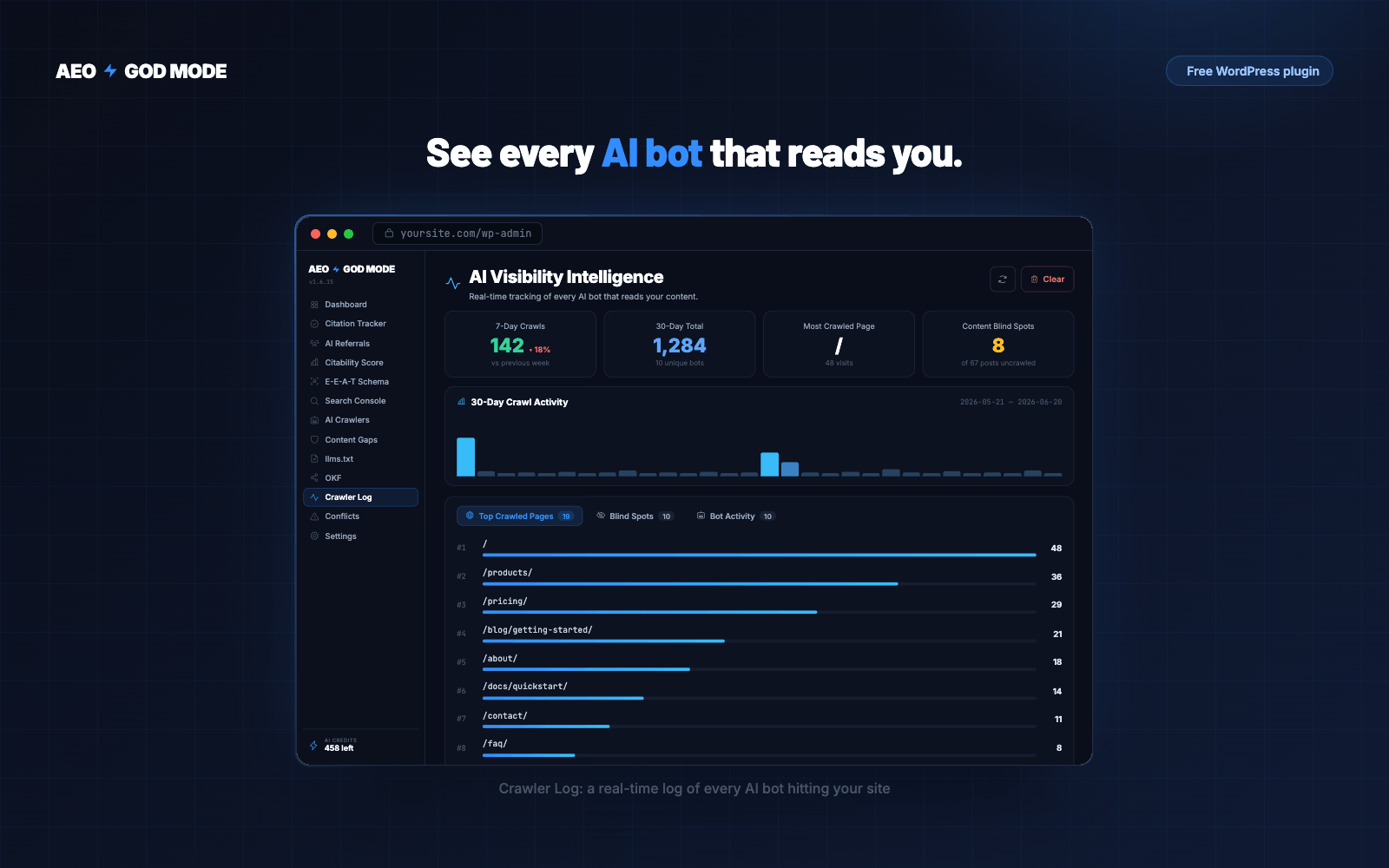
Step one is binary and takes five minutes. The free plugin shows which of the 18 AI crawlers can currently reach your pages. Download it free.
Step 2: make the content extractable
This is where most of the real work is, and it is unglamorous. An answer engine assembling a response needs a passage it can lift that still makes sense on its own.
Answer in the first 60 words
Directly under the heading, in full sentences. Not a preamble about why the topic is important.
Name the subject in every paragraph
“It” and “this” are invisible to an extractor. Say the noun.
Question-shaped headings
A heading matching the question, with the answer beneath, gives a retriever a clean unit.
One idea per paragraph
Three ideas in one block means an engine either takes all three or none.
Step 3: get the schema right, for the right reason
Structured data belongs in an AEO plan, but not for the reason usually given. It does not buy citations. It prevents misunderstanding, and it governs eligibility for Google result features you may already qualify for.
On WordPress the practical concern is not adding schema, it is having too much of it. Most sites already emit schema from their theme and their SEO plugin. Two systems writing the same node produces contradictory output, and the usual symptom is a rich result quietly vanishing.
Check this before adding anything
View source on your homepage and count the application/ld+json blocks. If you find two Organization nodes or two WebSite nodes, fix that first. Adding a third source of schema to a site that already contradicts itself makes the problem worse, not better.
Step 4: measure, or you are guessing
You need three signals, and all three are free.
| Signal | Where | Tells you |
|---|---|---|
| Crawler hits | Server access log | Whether engines can read you at all |
| Citations | Query the engines, log results | Whether you are named for questions you care about |
| Referral visits | Analytics referrer report | Whether any of it sends real people |
Referral data is the one to trust most, because it is the only one that connects an engine to an outcome. A citation you cannot tie to a visitor is a vanity metric.
What to skip
- llms.txt, as a visibility play. It is a proposed convention. No major lab has confirmed reading it, and analysis of server logs has found the file frequently receives no requests at all. Harmless to publish, but do not count it as done work.
- Keyword density for AI. There is no evidence any model weighs term frequency the way a 2010 SEO tool did.
- Any single AEO score. A number combining schema completeness, readability and word count is a composite of unrelated units. It will move while your citations do not.
The honest summary
AEO on WordPress is mostly access, structure and measurement. Access is binary and checkable. Structure is craft. Measurement is free. Everything beyond those three is currently inference, and any guide that does not distinguish the three from the rest is selling certainty nobody has.
Do steps 1 and 4 in an afternoon
The setup wizard takes you from install to configured in under five minutes, importing what you already have in Yoast or Rank Math.
- Crawler allowlist for 18 AI bots
- Crawler log and schema conflict detection
- Free, no account, no card
Keep reading
How to check which AI bots are crawling your site
Server logs are the only complete record. Analytics cannot see crawlers at all.
Best AEO plugin for WordPress: an honest comparison including ours
Compared on capability, not adjectives. Including when you do not need one.
Schema validator: check your markup and understand what the errors mean
Valid, eligible and shown are three different things. Plus the errors nobody explains.
Frequently asked questions
What is answer engine optimization for WordPress?
It is the work of making a WordPress site usable by AI answer engines: allowing the right crawlers to reach your pages, structuring content so passages can be extracted cleanly and quoted accurately, and measuring crawler access, citations and referral traffic. It sits alongside traditional SEO rather than replacing it.
Do I need an AEO plugin for WordPress?
Not necessarily. Crawler access can be checked in robots.txt and server logs, structure is a writing decision, and referral data is already in your analytics. A plugin makes those faster and puts them in one place, but nothing here is impossible by hand.
Does AEO replace SEO?
No. Indexing, crawlability and page quality still determine whether you are found at all, and Google AI Overviews and Perplexity both lean on search results. AEO adds a layer for engines that select and quote sources differently.
Will llms.txt help my WordPress site get cited?
There is no evidence that it will. llms.txt is a proposed convention that no major AI lab has confirmed reading, and studies of server logs have found the file often receives no requests. Publishing one is harmless, but it should not be counted as meaningful AEO work.
How long does AEO take to show results?
Crawler access changes are immediate and verifiable in your logs within days. Content and structure changes depend on recrawling and on the engine’s own update cycle, so expect weeks. Anyone promising a specific timeline for citations is guessing.