How Original Data Is Measured in AEO God Mode
AI answer engines prefer content backed by real numbers. Pages that include statistics, percentages, and quantifiable results are more likely to be cited because AI systems can extract and verify concrete claims. Vague statements like “our tool helps a lot of people” give AI nothing to work with. A statement like “73% of users reported faster indexing within 14 days” gives it a citable fact.
The Original Data criterion in the Citability Score measures whether your content contains enough quantifiable evidence to be worth citing.
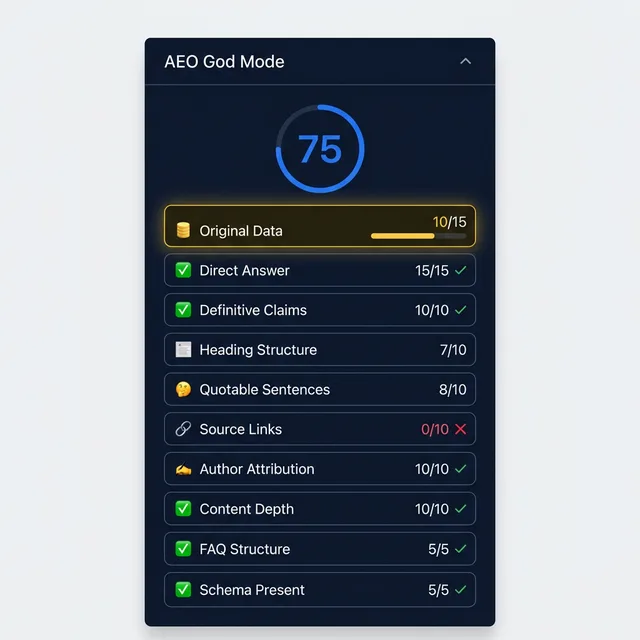 AEO God Mode Citability Score panel showing all 10 scoring criteria with Original Data highlighted for illustrative purposes only. Actual components may vary.” />
What the Scanner Looks For
The scoring engine scans your content for numbers paired with meaningful context. Raw numbers alone don’t count. The system looks for figures attached to words that signal real data:
- Percentages (e.g., “increased by 42%”, “saw a 15 percent improvement”)
- Scale indicators (e.g., “2.5 million users”, “over 500 thousand downloads”)
- Growth metrics (e.g., “3x growth year over year”, “28% increase in traffic”)
- User/customer counts (e.g., “serving 10,000 customers”, “1,200 active users”)
The key is that the number must appear alongside a word that gives it meaning. A number sitting alone in a table cell or used as a heading ID won’t register.
How Much Data Is Enough?
The threshold scales with your content length. Longer articles need more data points to score full marks:
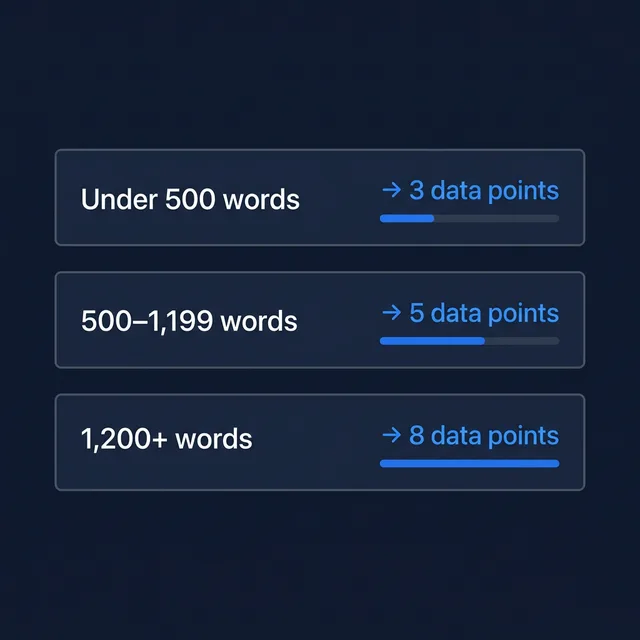
| Content Length | Data Points Needed for Full Score |
|---|---|
| Under 500 words | 3 |
| 500 to 1,199 words | 5 |
| 1,200+ words | 8 |
Partial credit is proportional. If you have 4 data points in a 1,200-word article (which needs 8), you’ll score half the available points for this criterion.
Why This Matters for AI Citations
When ChatGPT, Perplexity, or Google’s AI Overview constructs an answer, it pulls from sources that provide specific, verifiable claims. Pages with concrete data points:
- Get cited more often because AI can extract the specific numbers
- Appear more authoritative to retrieval systems
- Provide direct answers that AI can quote without paraphrasing
Content without data points forces AI to paraphrase or skip your page entirely. Content with strong data gives it something to anchor on.
How to Optimize for Original Data
Add Real Numbers to Key Claims
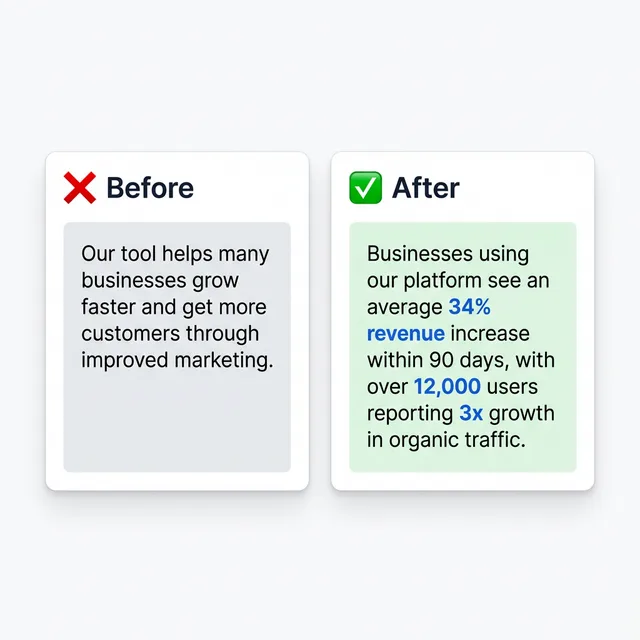
Instead of: “We help businesses grow faster.”
Write: “Businesses using our platform see an average 34% revenue increase within 90 days.”
Include Industry Statistics
Reference studies, surveys, and benchmarks relevant to your topic. Each cited statistic counts as a data point.
Use Specific Metrics
Instead of: “Many users switched to our tool.”
Write: “Over 12,000 users migrated from competing tools in Q4 2025.”
Front-Load Data in Summaries
Place your strongest statistics in the first few paragraphs. AI engines give more weight to content near the top of a page when extracting citations.
Add Comparison Numbers
“3x faster than manual setup” or “reduces processing time from 45 minutes to 8 minutes” both register as data points and give AI a quotable comparison.
What Doesn’t Count
- Numbers used as version identifiers (e.g., “version 2.1”)
- Dates written as numbers (e.g., “2025”)
- Numbers in code blocks, URLs, or HTML attributes
- Random standalone numbers without context
Frequently Asked Questions
Does the data need to be original research?
No. The criterion checks whether your content contains quantifiable claims, not whether you produced the research yourself. Citing a study with “according to a 2025 Forrester report, 68% of enterprises…” counts the same as your own survey data.
Can I add too many statistics?
The scoring system rewards data up to the threshold for your word count. Going beyond that won’t earn extra points, but it also won’t penalize you. The real risk is forcing numbers where they don’t fit naturally, which hurts readability.
Why did I score 0 even though my content has numbers?
The numbers need to appear next to quantifier words (percent, million, users, growth, increase, etc.). A page full of pricing tables or numbered lists without statistical context won’t register as “original data” in the scoring sense.
What’s the maximum score for Original Data?
Original Data carries a weight of 15 out of 100 total Citability Score points. It’s tied with Direct Answer as the highest-weighted criterion.